

Respiratory Protection: Safety, Compliance, and Field Expertise
Develop a compliant respiratory protection program and protect workers exposed to airborne contaminants.
Our specialists help you assess workplace hazards, select appropriate respiratory protective equipment, perform respirator fit testing, and implement a program that complies with CSA Z94.4 requirements.
Do You Know...
- Whether your workers are wearing the right respirators for the hazards they face?
- Whether your respirator fit tests are up to date?
- Whether your respiratory protection program meets current regulatory requirements?

STRENGTHEN YOUR RESPIRATORY PROTECTION PROGRAM
Comprehensive solutions designed to protect workers and ensure regulatory compliance across your operations.

Reduce exposure risks

Ensure regulatory compliance

Improve respirator selection

Avoid costs related to incidents

Standardize your practices

Be audit-ready

Strengthen your safety culture

Maximize your return on investment
A COMPLETE RESPIRATORY PROTECTION OFFERING
From hazard assessments to full program management, our specialists support you every step of the way.
Respiratory protection consulting
Develop or improve your respiratory protection program with the support of our experts.
✓ Development or revision of written respiratory protection programs
✓ Program and workplace practice audits
✓ Training program development and train-the-trainer services
✓ Development of respirator use and maintenance procedures
✓ Regulatory guidance and compliance support
Respirator fit testing services
Ensure every worker receives adequate respiratory protection.
✓ Qualitative and quantitative fit testing
✓ N95 respirators, half-mask respirators, and full-face respirators
✓ In-branch or on-site services
✓ Certified fit testing technicians
✓ Complete documentation and recordkeeping
Respiratory protection training
Build worker knowledge and competency.
✓ Proper respirator use✓ Inspection and maintenance procedures
✓ Qualitative fit testing training
✓ Quantitative fit testing training
✓ Training aligned with regulatory requirements
Respiratory protective equipment
Access the right respiratory protection equipment for your workplace hazards.
✓ Disposable N95 respirators
✓ Half-mask and full-face respirators
✓ Powered Air-Purifying Respirators (PAPR)
✓ Cartridges and filters
✓ Self-Contained Breathing Apparatus (SCBA)
Gain a better understanding of workplace exposure risks.
✓ Asbestos and silica assessments
✓ Breathing air quality analysis
✓ Indoor air quality assessments
✓ Air contaminant monitoring
✓ Corrective action recommendations
Equipment rental and inspection services
Access certified equipment only when you need it.
✓ Short- and long-term rentals
✓ Ideal for shutdowns and special projects
✓ Equipment inspection and certification
✓ CSA-compliant inspections and certifications
✓ Available in our service centres or directly at your site
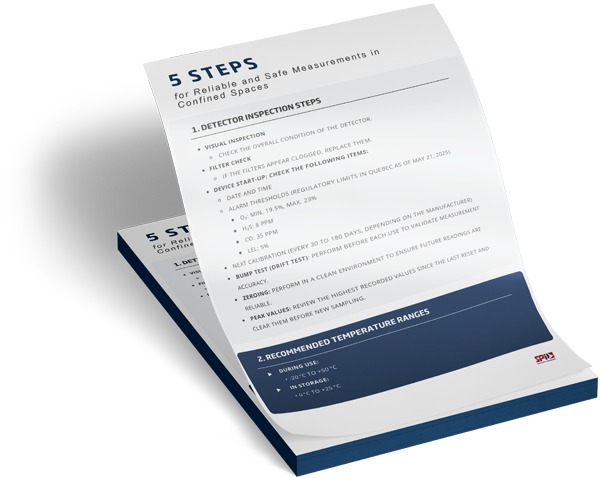
5 essential steps...
Discover the 5 essential steps for reliable and safe confined space monitoring.
WHY CHOOSE SPI HEALTH AND SAFETY?

Certified and Specialized Experts
A team trained and recognized in the field of working at heights.
Regulatory Expertise
Extensive knowledge of CSA standards and provincial regulations.
Turnkey solutions
Consulting, training, fit testing, and equipment, all under one roof.
Proven Results
Thousands of projects successfully completed across multiple industries.
National presence
A network of specialists serving organizations across Canada.
Trusted Customer Service
Commitment to timelines, budgets and solving complex challenges.



Branches and service locations across Canada
Meet our health and safety experts
Our services are built on human expertise. Get to know one of our specialists who supports organizations like yours every day.

Leslie Arisbeth Guzman
Training Advisor and Industrial Hygiene Technician
Leslie is trilingual and specializes in respiratory protection and air quality sampling. She has strong expertise in occupational health and safety regulations and the CSA 94.4 standard on respiratory protection. Curious and passionate about industrial hygiene, she is an excellent communicator—whether in training sessions, identifying client needs, or recommending workplace improvements. Always eager to stay up to date, Leslie regularly brings forward innovative ideas to enhance our services and training programs.
Areas of expertise
Respiratory protection and industrial hygiene
OUR RESPIRATORY PROTECTION PROGRAM IMPLEMENTATION PROCESS
1. Hazard assessment
Identify airborne contaminants and high-risk tasks within your workplace.
2. Needs analysis
Determine regulatory, operational, and workforce requirements.
3. Solution selection
Select the appropriate respiratory protective equipment, procedures, and controls.
4. Training and fit testing
Validate respirator effectiveness and ensure workers are properly trained.
5. Ongoing support
Keep your program up to date through ongoing reviews, reminders, and expert guidance.
FREQUENTLY ASKED QUESTIONS (FAQ)
A respiratory protection program is required whenever workers are exposed to airborne contaminants that may pose a health risk. In many jurisdictions, employers providing respirators must develop and implement a respiratory protection program that complies with CSA Z94.4, Selection, Use, and Care of Respirators.
A respiratory protection program starts with identifying and assessing workplace contaminants to determine whether respiratory protection is required and which type of respirator is appropriate for the level of risk.
A complete program should define roles and responsibilities, respirator selection, worker training, fit testing, proper use procedures, and requirements for cleaning, inspection, maintenance, and storage. It should also include health surveillance when required, recordkeeping, and periodic evaluations of the program’s effectiveness.
Expert tip: Respirator selection should always be based on the hazard and contaminant assessment. Simply providing workers with respirators does not, on its own, constitute a respiratory protection program.
CSA Z94.4 recommends that respirator fit testing be conducted at least every two years, or whenever changes occur that could affect respirator fit, such as significant weight changes, dental work, or facial surgery.
Qualitative fit testing relies on the worker's sensory response to determine respirator fit, whereas quantitative fit testing uses specialized instruments to measure respirator leakage and provide objective fit data.
In most cases, facial hair prevents a proper seal from forming between the respirator and the face, reducing the effectiveness of tight-fitting negative-pressure respirators.
N95 respirators, half-mask respirators, and full-face respirators can all undergo fit testing depending on their intended use and workplace requirements.
Choosing a respirator starts with identifying the contaminants and assessing the level of exposure. You can then select a respirator that provides the appropriate level of protection, is compatible with other PPE, and fits the worker properly. A fit test may also be required to confirm the seal of a tight-fitting respirator.
Ready to Move Forward? Here’s What’s Next!

Give Us the Details of Your Needs
Call us or fill out the form and tell us more about your requirements.

Our Experts Will Get Back to You
Our team will evaluate your request and provide a tailored solution to meet your specific workplace safety needs.

Let Us Do the Work!
Take advantage of the expertise of our certified technicians.

Ready to Strengthen Your Respiratory Protection Program?
Work with specialists who can help you protect your workforce and ensure regulatory compliance.
✓ Free virtual consultation
✓ Solutions tailored to your operational realities
✓ Fast response from our experts
Contact us by filling out the form.
Or call us toll free: 1-877-544-0911